Table of contents

Introduction
Every coffee shop menu I remember from growing up in Japan had the same short list on it.
Burendo (ブレンド), the house blend. Buruman (ブルマン), short for Blue Mountain. Kiriman (キリマン), Kilimanjaro. And Mocha (モカ).
When the menu mentioned Mocha, I understood it as a kind of bean. You ordered it black, it came in a small cup, and on a typical kissaten (喫茶店) menu it cost the same as the Kilimanjaro, a notch more than the Brazil.
Then I moved to the USA, and noticed that when people say mocha, it means a chocolate drink. At that time, I was confused but I just carried on and mocha meant chocolate drink for me since ever.
Now I was discussing with Sapporo Coffee Kan about the season Aki Autumn Blend (あき) and they mentioned it has mocha. The blend built on a natural-processed Mocha Sidamo taken to French roast.
Then that flashed back my memory 20 years ago when I got confused.
Well, I thought it may be a good topic for me to dig in and write about this, so this article is about...
Mocha.
What is mocha?
Read on, it's interesting, especially if you are from Japan, living/lived/traveled or want to go to Japan and love coffee, like me. (^^)
Enjoy!

Mocha the Bean and Mocha the Drink
In the coffee trade, Mocha means coffee from Yemen or Ethiopia. It has meant that for a few hundred years.
The chocolate drink is much younger. The Oxford English Dictionary's first citation for mocha as a fine coffee is from 1773, in a letter by a physician named John Pringle. The coffee-and-chocolate sense turns up in the 1800s, by 1849 according to Etymonline, and the OED's earliest café mocha, meaning the chocolate-flavored drink we order today, is from a 1977 Washington Post piece.
Drinkers apparently heard chocolate in the coffee itself. Good Yemeni beans carry a chocolate-like note.
The espresso version, chocolate syrup under steamed milk, is American.
Starbucks opened its first espresso bar in 1984, and the drink was on menus nationwide by the 1990s.
The Port of Mocha (Al-Makha), Yemen
 The port of Mocha, Yemen. The harbour silted up and the town emptied, but the name outlasted it by four hundred years.
Mocha is a town on Yemen's Red Sea coast. Al-Makha in Arabic, Mokha on some maps.
From what I've read the Ottomans developed it as a port from 1538, and for roughly two centuries after that it was the main outlet for Yemen's coffee, with English, Dutch and French trading houses on site by the late 1600s.
Ethiopia is just across the water, and Ethiopian beans crossed the Red Sea and shipped out through the same Yemeni ports.
 Mocha sits on the Yemeni side of the Bab al-Mandab Strait. Ethiopia is the coast opposite, which is how the coffee of two countries left under one name.
Buyers apparently did not separate the two very carefully. So now coffee coming from both Ethiopia (Abyssinian) and Yemenare still called mocha.
How much of it passed through Mocha itself rather than another Yemeni harbor is not well documented.
Until then the Red Sea was the only place in the world to buy coffee. Then the Dutch stopped buying and started growing their own.
They got coffee seedlings to Java, Indonesia in 1699 and sold the first Java crop at auction in Amsterdam in 1711, about 405 kg (894 lb) of it.
Coffee reached Brazil in 1727. By the mid-1800s Brazil was growing more coffee than anywhere else in the world, and nobody needed Yemen any more.
The harbor silted up, the British moved their base to Aden in 1839, and Mocha's population fell from about 20,000 in the early 1800s to about 1,000 by the 1930s.
A Japanese writer I came across put it, roughly translated, as the port dying and only the name surviving, for four hundred years.
I was hoping that some of the history of the coffee still remains for the coffee lovers today to see when visiting the city, but from what I researched, there would be almost nothing left to see there as the city went through tough times with plague in 1700 and British East India Company destroyed the north and south forts in 1820.
In Japan that naming is still in use.
Here iswhat you hear the most:
Mocha Matari (モカマタリ) is Yemeni, from the Bani Matar district west of Sana'a.
Mocha Harrar (モカハラー), Mocha Sidamo (モカシダモ) and Mocha Yirgacheffe (モカイルガチェフェ) are Ethiopian, each named for a region.
Let me explain each one in the next sections.
Sidamo and the Natural Process
Our limited-time Aki Autumn Blend (あき) is built on a natural-processed Mocha Sidamo.
Sidamo is the old trade name for coffee from Sidama, in the southern Ethiopian highlands along the Great Rift Valley.
 Sidama sits in the southern highlands along the Great Rift Valley, with Yirgacheffe and Guji beside it.
Sidama is the name of the people and the language, Sidamo is the version that stuck in the coffee trade, and Sidama became its own regional state on 18 June 2020 after a referendum with a 98.52 percent yes vote.
Most bags still say Sidamo, and so does Sapporo Coffee Kan's spec sheet, so I use both here.
Before going into detail about Sidama, since Sidama is part of Ethiopia, let me brief about Ethiopia coffee first.
Brief About Ethiopian Coffee
As you may know, Ethiopia is where arabica originated.
The mountain forests of the southwest are where Coffea arabica grows wild, and by the usual account the genetic root of the cultivated arabica grown everywhere else.
From what I have read that one word stands in for thousands of arabica landraces that have adapted to their own valleys over centuries, with 10,000 to 15,000 genotypes the figure most often cited, and Ethiopia holding more arabica genetic diversity than every other coffee-growing country put together.
The country is the world's fifth-largest producer, after Brazil, Vietnam, Colombia and Indonesia.
Sidama Coffee and Natural Processing
Sidama grows most of Ethiopia's Grade 1 and Grade 2 coffee, the top two bands of the national grading system.
Coffee grows there at about 1,500 to 2,200 m (4,900 to 7,200 ft) on volcanic soil.
Farmers there use both processing methods, washed a little more often than natural.
The coffee we use in Aki Autumn Blend (あき) uses natural processing.
 Natural processing: the whole cherry dries on raised beds for two to four weeks, with the bean still inside its own sugar.
Natural means the cherry is dried whole.
Pickers take only the ripe red fruit, spread it on raised mesh beds about a meter (3 ft) off the ground, and turn it for two to four weeks until the moisture drops to around 10 to 12 percent.
The bean sits inside its own sugar the whole time.
Only then is the dried fruit hulled off.
Washed coffee, the other main method, strips the fruit first, ferments the beans for 12 to 72 hours to loosen the sticky layer, and dries them in 10 to 15 days.
The difference in the cup comes from those weeks inside the fruit.
Yeasts and bacteria ferment the fruit sugars into alcohols and esters that migrate into the bean, so naturals taste of berry and wine, sometimes chocolate, with a heavier body.
Washed coffees come out cleaner and lighter, more citrus than fruit.
People describe a natural Yirgacheffe as blueberry.
The washed version of the same coffee gets called jasmine.
Our post on how harvesting and processing affect taste goes further.
Aki's Mocha Sidamo is a natural.
 Natural against washed. Aki’s Mocha Sidamo is the left-hand column.
Mocha, Yirgacheffe, Harrar and Guji
Since we talked about Mocha Sidamo, let's talk about the other mocha types. Mocha Yirgacheffe (モカイルガチェフェ), Mocha Harrar (モカハラー) and Mocha Guji.
I may be getting into too much detail, so skip this section unless you really want to know the technical differences of these "mochas". (This is my bad habit of wanting too much information.:0)
Mocha Harrar (モカハラー)
Harrar is the eastern one, named after the walled city of Harar, and the crop there is dry-processed almost without exception. Harrar lots get graded by bean size into longberry, shortberry and Mocha. That third grade means peaberry, the single round seed you get when only one forms inside the cherry instead of the usual pair.
So on a bag of Harrar the word Mocha is not the origin at all. It is the screen size.
Mocha Yirgacheffe (モカイルガチェフェ)
Yirgacheffe (イルガチェフェ) is a district. It is one of seven woreda in the Gedeo zone, and the coffee area that carries the name covers most of Gedeo plus a slice of Guji. It sold under the Sidamo designation for years before it got its own, and the Ethiopian Commodity Exchange defined Yirgacheffe A and B as separate grades in 2008. Coffee there grows higher than most of Sidama, roughly 1,700 to 2,200 m (5,600 to 7,200 ft).
Mocha Guji
Guji is a zone in Oromia, directly south of Sidama. Its coffee sold as Sidamo for decades. Farms there work above 2,000 m (6,600 ft), higher than most of Sidama, and send out washed and natural lots both.
Ethiopia vs USA and Starbucks Battle
There is an interesting story about the name.
The Ethiopian government filed to trademark Yirgacheffe, Harrar and Sidamo in the United States.
The applications went in through the Ethiopian Intellectual Property Office in March 2005, part of a national programme to license the names back to roasters so that growers earned more from them.
The National Coffee Association, the US industry body, opposed the filings with Starbucks behind it, arguing the names had gone generic.
In June 2007 Starbucks signed a licensing agreement recognising Ethiopia’s ownership of all three.
From what I have read the USPTO approved Harrar in 2006 and Sidamo in 2008.
Japan's Love of Mocha
 A kissaten menu, where モカ sits next to キリマンジャロ and ブルーマウンテン. On a Japanese menu Mocha has always been a bean.
Some people say Mocha was the Showa-era (昭和) kissaten bean. UCC, the biggest roaster in the country, called it Japan's number-one bean by popularity in a 2010 press release, and Key Coffee still sells a Mocha Blend that is 60 percent Ethiopian Mocha.
The affection has outlived the kissaten boom.
On the Japanese voting site みんなのランキング, a word Mocha (モカ) sits second among coffee bean names at 79.6 points, behind Blue Mountain (ブルーマウンテン) at 92.3 and ahead of Kilimanjaro (キリマンジャロ), Colombia (コロンビア) and Brazil (ブラジル).
That is a popularity poll and not sales data, so the point spread is worth nothing on its own. The order is what caught me, because it is the old kissaten menu almost line for line, forty years on.
Mocha Matari has a nickname in Japan, the lady of coffee (コーヒーの貴婦人). It also got a hit song. Sachiko Nishida's Coffee Rumba (コーヒールンバ) from 1961 gets credited with pushing Mocha's popularity further.
No relation, as far as I know.
The 2008 Mocha Shortage
Here is another interesting story I found about mocha.
In late April 2008, Japan's health ministry found lindane above the legal limit in Ethiopian green coffee, and on 9 May it ordered every lot tested for lindane, chlordane and heptachlor before entry.
The limit for lindane was 0.002 ppm, a thousand times stricter than the 2 ppm allowed on cucumbers and fifty times stricter than the EU's 0.1 ppm for coffee.
By the figures I found, about 90 percent of the 2007/08 crop failed.
Every-lot testing became a ban in practice. UCC stopped selling Mocha in July 2008, Key Coffee dropped it by September, and kissaten took it off the menu, some for the first time since they opened.
About 98 percent of Japan's Mocha was Ethiopian, so there was no Yemen to fall back on.
In 2009 Japan imported 448 tonnes (494 US tons) of Ethiopian green coffee. The pre-2008 figure was 8,948 tonnes (9,900 US tons) in 2007 by the trade statistics, though one magazine account puts it near three times that. Either way the drop is well over 90 percent.
The cause, from what the industry's inspection team reported, was reused burlap sacks that had carried pesticide-treated crops.
How large Japan looked from the Ethiopian side is harder to establish.
One Japanese coffee site states that before the crisis Japan was Ethiopia's biggest single-country buyer outside the EU, at roughly 40,000 tonnes (44,000 US tons) in 2006. I have found that figure in exactly one place and nowhere in the trade statistics, so I am flagging it as low confidence rather than leaving it out.
UCC brought Mocha back in September 2009, AGF and Key Coffee followed in early 2010, and the last inspection order was lifted in April 2012. A UCC executive said during the gap, roughly translated, that a blend without Mocha in it does not taste the same.
Today Ethiopia is Japan's fifth-largest source of green coffee, 15,069 tonnes (16,600 US tons) in 2025, about 4.2 percent of imports, and it still sells here under the brand name.
Ethiopia is Mocha in Japan the way Tanzania is Kilimanjaro.
Measured the other way round, Japan's share of Ethiopia's crop has been shrinking.
The USDA's 2025 coffee annual for Ethiopia puts Japan at 6.1 percent of export volume in 2023/24, behind Saudi Arabia at 18.4 percent and Germany at 16.9 percent, against 10 percent two seasons earlier. World Bank trade data records 16,672 tonnes (18,400 US tons) going from Ethiopia to Japan in calendar 2023.
Mocha French (モカフレンチ), Japan’s Deep-Roast Habit
Another word you hear often in Japan is Mocha French.
Mocha French (モカフレンチ) was a popular coffee in the Showa kissaten. You still see the name everywhere in Japan.
You might have guessed it by now, Mocha French in Japan means Mocha roasted in French Roast.
As you know, French roast is a type of roasting.
It is the seventh stop on the eight-step scale roasters use, after light, cinnamon, medium, high, city and full city, and before Italian.
It lands at the end of second crack, somewhere around 235 to 246 °C (455 to 475 °F), with the bean very dark and just showing oil. Some roaster calls it gokufukairi (極深煎り).
 The eight steps Japanese roasters use. French is the seventh, just before Italian.
Darker roast on mocha works well because Mocha’s base character is acidity, and a dark roast destroys acidity. Chlorogenic acids drop by up to 90 percent. The bean starts with more sugar and body and less tartness, so what survives is fruit and sweetness instead of a hole where the acidity used to be.
That last step is my reasoning rather than a paper, but it matches what roasters who go this dark say about the beans they pick. How Roasting Affects the Taste of Coffee walks through the stages.
Aki Autumn Blend (あき) is built on a natural-processed Mocha Sidamo taken to French roast. In other words, in Japan you would call it Mocha French.
Binchotan Charcoal and the Deep Roast
And the last piece of the puzzle to make Aki Autumn Blend (あき) special is... you guessed it...
Sumiyaki.
You bought our coffee, then you know it already, but let me mention briefly here.
Sapporo Coffee Kan roasts over binchotan (備長炭) rather than gas, and their own page on the method opens by knocking down the assumption most people bring to it. Charcoal-roasted coffee equals black bitter coffee is, in their words, as far from the truth as it can get.
Aki is charcoal roasted like all the coffee we carry.
Binchotan is white charcoal, made from ubame oak (ウバメガシ), fired hot and then smothered in damp ash until it is pale, dense and hard enough to ring when two pieces knock together.
The same fuel a yakitori (焼き鳥) counter burns.
Sapporo Coffee Kan roasts on a 30 kg (66 lb) charcoal drum, the largest sumiyaki machine in Hokkaido as of 2026. Mr. Ito, the company’s chairman, runs it himself. The video below is that machine working.
videoid="ykGO7pYVfMw"
The charcoal does not sit in a burner. It burns in a chamber underneath the drum, so the heat reaches the beans as radiation rather than as hot gas, which is the whole reason the far-infrared argument comes up at all. A roaster works the fire by moving logs around and opening or closing the air, not by turning a dial.
This is what that chamber looks like with the binchotan lit. Learn more about how a sumiyaki roasting machine works.
 Picture of Binchotan Charcoal in the Sumiyaki Roasting Machine’s Chamber
Their case for it is three things.
Charcoal holds almost no water, so more of the fire’s energy reaches the bean instead of boiling moisture out of the fuel.
It puts out a high proportion of far infrared, which is said to carry heat evenly from the surface of the bean to its core. And once a bed of binchotan is hot it stays there, which is what makes a long roast possible at all.
They add a fourth claim, that the alkaline ash takes some edge off the acidity. I have not found a controlled test of the infrared or the ash claim and would not present either as settled, though every Japanese charcoal roaster repeats them.
The part that matters here is that charcoal is said to suit deep roasts in particular.
Hard, dense arabica whose body only opens up at a dark roast is the case Japanese roasters name as charcoal’s best use.
Which is Aki in one line.
Sidamo grown at 1,500 to 2,200 m (4,900 to 7,200 ft) comes out dense, and a dense bean needs heat that reaches the middle before the outside goes.
French roast is the deep end, where charcoal either earns its keep or does not.
Binchotan is what holds a steady temperature for the twenty-odd minutes it takes to get there.
It is a hard way to work.
Flame control over a charcoal bed is coarse next to a gas burner, and the same roasters who praise the method list scorch (焦げ) as its standard failure.
Sapporo Coffee Kan has been doing it since 1982, and our article about the roaster has that history.
Do you think I am going into too much detail?
I enjoy reading the story and detail of the coffee I am drinking as I sip a cup, and I hope you do too! (^^)
This Season's Blend: Aki Autumn Blend (あき)
Aki Autumn Blend (あき) is available now for you to try for limited time.
It is the autumn edition of Sapporo Coffee Kan's four-seasons series, one blend per season, each retired when its season ends.
I covered the series and the kisetsu gentei (季節限定) habit behind it in the July article, so I will not repeat it here.
Aki blends three origins, Ethiopia, Guatemala and Brazil, and a roast level is a blend of 3 and 5. (Higher the number, the darker the roast)
Japanese roasters distinguish pre-mix (プレミックス), where green beans are blended and roasted together, from after-mix (アフターミックス), where each origin is roasted to its own level and then blended.
The natural Mocha Sidamo goes to 5, French roast (you know why by now), on Sapporo Coffee Kan's five-point scale, and the Guatemala and Brazil sit at 3.
The French-roast Mocha supplies the bittersweetness and the body.
The lighter half keeps some acidity, sweetness and a nut-and-chocolate aroma that a French roast would burn off.
Here is the tasting profile:

Tasting Notes
Bitterness 4 and acidity 2 describe the front of the cup. Deep-roast bitterness first, very little sourness. Body 4 is the natural Sidamo's weight. The sweetness, a 3, and the Mocha aroma arrive after the swallow.
Deep-roasted Mocha blend with a lingering sweetness and a warm, clean finish.
The word Sugimoto-san from Sapporo Coffee Kan used for the blend is hokkori (ほっこり).
I don't know how to translate this word in English.... Warm and a little relaxed is the closest I have got, and I am not sure that is right.
Natsu Summer blend's bitterness was kiritto (キリッと), sharp notes. Against Natsu , it is less snap and more linger.
The blend is where you can taste what Mocha really is, with a sweetness and aroma that spread out as the aftertaste.


Aki Autumn Blend (あき) is available here →
The Meaning of Aki (あき)
Aki (あき) means autumn.
The kanji is 秋 but we kept ours in hiragana, あき, the way we did with なつ. It feels more like Japan, don't you think?
In Japan autumn is the eating season. Convenience stores switch to sweet potato, chestnut and pumpkin, and sanma (秋刀魚), the Pacific saury, runs south past Cape Erimo in Hokkaido from September.
Hokkaido gets autumn first.
Leaves start turning on Mt. Asahidake, 2,291 m (7,516 ft), in early September, the earliest color in Japan.
Sapporo peaks in early to mid October, and Ebetsu (江別), where Sapporo Coffee Kan roasts, is flat farmland next door and turns at about the same time, from what I can tell.
 Hokkaido turns first. Leaves start on Mt. Asahidake in early September, weeks ahead of the rest of Japan.
Aki vs. Hokkaido Blend vs. French Roast Blend
Here is how we compare with our medium Hokkaido Blend and the dark French Roast Blend.
| Hokkaido Blend | French Roast Blend | Aki Autumn Blend | |
|---|---|---|---|
| Roast | Medium | Dark, one level throughout | After-mix of 3 and 5 (Mocha at French roast) |
| Origins | Colombia, Brazil, Honduras, Indonesia | Colombia, Brazil, Indonesia | Ethiopia, Guatemala, Brazil |
| Character | Smooth, mild bitterness, full body | Roast-forward, heavy, bittersweet | Deep-roast bitterness, low acidity, sweet Mocha finish |
| Reach for it | Anytime, any method | Strong black coffee, espresso-style drinks | Autumn, hot or as café au lait |
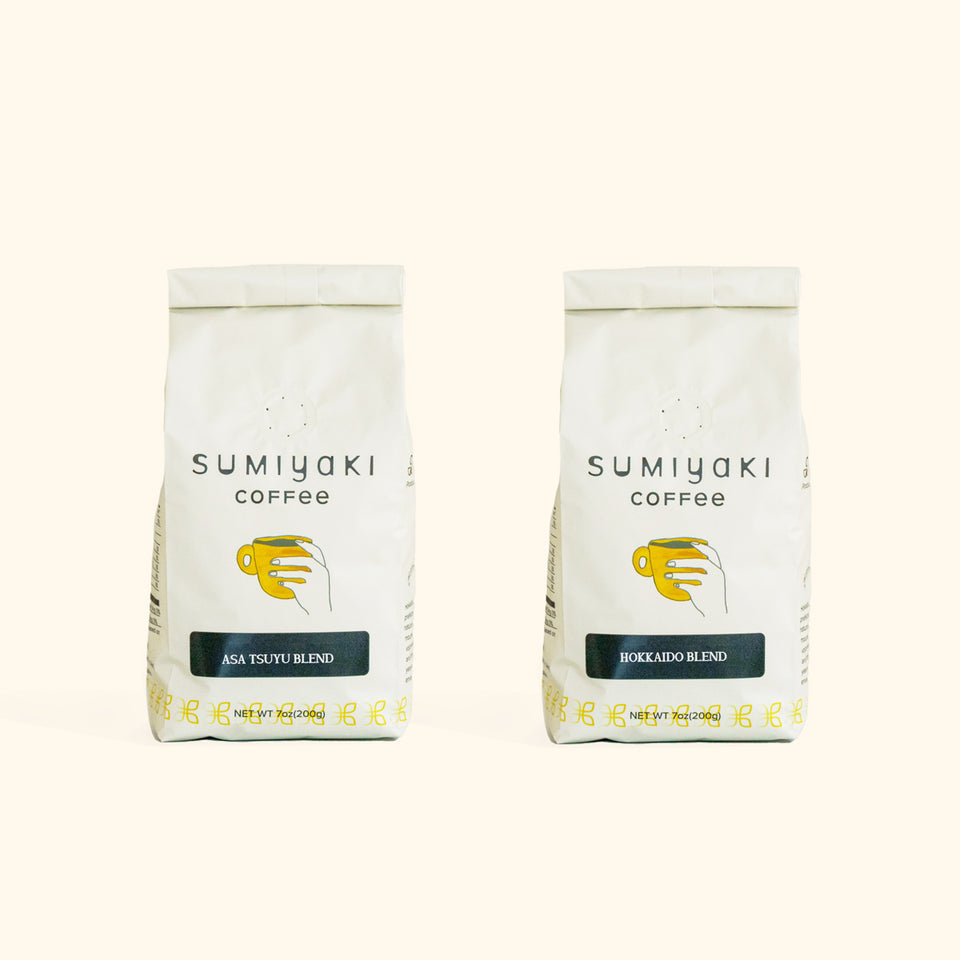
French Roast Blend takes Colombia, Brazil and Indonesia to the same deep level, so what you taste is mostly roast. Aki only takes the Mocha that far. The Guatemala and Brazil stay at 3, which leaves an aroma and a fruit finish French Roast Blend has no way to produce. Hokkaido Blend is medium and has no Ethiopia in it. (Ethiopia is also in Asa Tsuyu, at light roast, and in Decaf Premium.)
Picking one?
If you want a straight dark roast with nothing fruity in the way, French Roast Blend. If you want one bag for every morning, Hokkaido Blend, still our best-seller.
If you want to find out what Mocha tastes like, that is Aki Autumn Blend, until the season turns.
Hokkaido Autumn Café au Lait
When we published Summer Blend article, people mentioned they enjoyed the recipe to go with it, so let us do one more time.
This time, how about Hokkaido Autumn Café au Lait?
You know that Hokkaido is famous for their milk, right?
Fun fact: Hokkaido produces more than half of Japan's raw milk.
Milkland Hokkaido's figure for FY2013 is 3,848,584 tonnes and a 51.7 percent national share, and the share has stayed over half every year since FY2010. J-Milk's FY2024 numbers put Hokkaido at about 4.24 million tonnes out of a national 7.39 million, which is near 57 percent.
In the 1960s the island's share was about 20 percent. The herd moved north over sixty years, and that is why a milk drink is the obvious thing to do with a Hokkaido autumn coffee.
Café au lait (カフェオレ) in Japan means drip coffee and warmed milk at about 1:1. A latte is espresso and steamed milk at roughly 1:4, a different drink. The kissaten version uses a deep-roast bean brewed strong so the coffee is not lost in the milk. That is Aki's profile.
UCC's professional tip is 12 g (0.4 oz) of coffee to 60 ml (2 fl oz) of water, then 200 ml (6.8 fl oz) of milk.
That is stronger than I like with a French-roast bean.
This is the ratio I use with our French Roast Blend and it is where I would start with Aki.
 Hokkaido Autumn Café au Lait, dusted with kinako.
You'll need:
- 20 g (0.7 oz) Aki Autumn Blend, ground medium-fine
- 150 ml (5 fl oz) hot water, about 90 °C (194 °F)
- 150 ml (5 fl oz) whole milk
- Optional: a pinch of kinako (きな粉), roasted soybean flour, or a little brown sugar
Method:
- Brew the 20 g of coffee with the 150 ml of hot water, pour-over or drip. It will look too strong on its own. That is the idea.
- Warm the milk in a small pan to about 65 °C (149 °F), steaming but not bubbling. Above about 70 °C (158 °F) a skin forms and the milk loses its sweetness, so do not let it boil.
- Pour the coffee and the milk into a warmed cup together, half and half.
- Taste it before you add anything. If you want the autumn version, dust the top with kinako or stir in a little brown sugar.
Download Printable Recipe PDF Now
Milk tastes sweetest at around 60 to 65 °C (140 to 149 °F), which is why the temperature matters more than the ratio.
If you try the kinako, please tell me how it goes. I'm curious. (FYI, I wasn't a fan of it, and many coffee lovers will scold at me that I suggested to add kinao to coffee...)
The Music for Autumn
Sapporo Coffee Kan's founder and chairman, Ito Eiichi-san (伊藤栄一), pairs each seasonal blend with music by Tōne (遠TONE音), a shakuhachi, koto and guitar trio with two of its three members from Hokkaido. The full story, including the Carlos Santana pun in their name, is in the July article.
The three are Mitsuzuka Yukihiko (三塚幸彦) on shakuhachi (尺八), Ono Mihoko (小野美穂子) on koto (箏) and Soyama Ryoichi (曽山良一) on guitar. They met as guest players behind the singer Kurahashi Ruiko (倉橋ルイ子) and formed the group in 1988.
For autumn Sugimoto-san sent two tracks. The first is Akanegumo (茜雲), clouds dyed madder red by the sunset. Their English title is Dark Red Clouds, and this recording is from a 2019 concert in Tokyo.
videoid="OMlwZ7jsNPc"
The second is Kita Hikō (北飛行), northern flight, which the group titles Riding the Northern Sky in English. From what I can find it opens their 1995 album, The Music of Earth/3rd.
Sugimoto-san's note, translated, was that the tone of these two evokes the vast autumn land of Hokkaido. The Tokachi region named them its sound ambassadors in 1994.
I hope you get to enjoy the Aki Autumn Blend (あき) watching these videos and reading again this long article to feel the autumn of Japan a bit wherever you are.
Quick Reference: Aki Autumn Blend (あき)
| Name | Aki Autumn Blend (あき). Aki means autumn. |
| Roast | After-mix of 3 and 5 on Sapporo Coffee Kan's scale (Mocha Sidamo at 5, French roast) |
| Origins | Ethiopia, Guatemala, Brazil |
| Base bean | Natural-processed Mocha Sidamo, from Sidama in southern Ethiopia, at about 1,500 to 2,200 m (4,900 to 7,200 ft) |
| Tasting profile | Deep-roast bitterness, low acidity, sweetness and Mocha aroma that arrive in the finish |
| Flavor ratings | Aroma 3 · Body 4 · Acidity 2 · Bitterness 4 · Sweetness 3 (of 5) |
| How to drink | Hot and black, or as a Hokkaido Autumn Café au Lait – 1:1 with milk warmed to 65 °C (149 °F) |
| Availability | Autumn only – on sale from the week of 7 September 2026, retires when the season turns |
Related products


![Asa Tsuyu Blend [Light Blend] Coffee (Colombia, Brazil, Ethiopia)](http://japanesecoffeeco.com/cdn/shop/files/web-ready_Asa_Tsuyu_Blend_life-style.jpg?v=1754689231&width=960)


Get Free Bonus Books

Sign up for free to the Coffee Club to get advice and exclusive articles about how to choose Japanese Coffee, and tips, tricks, and recipes for enjoying Japanese coffee.
About the author

Kei Nishida
Author, CEO Dream of Japan
Certifications: PMP, BS in Computer Science
Education: Western Washington University